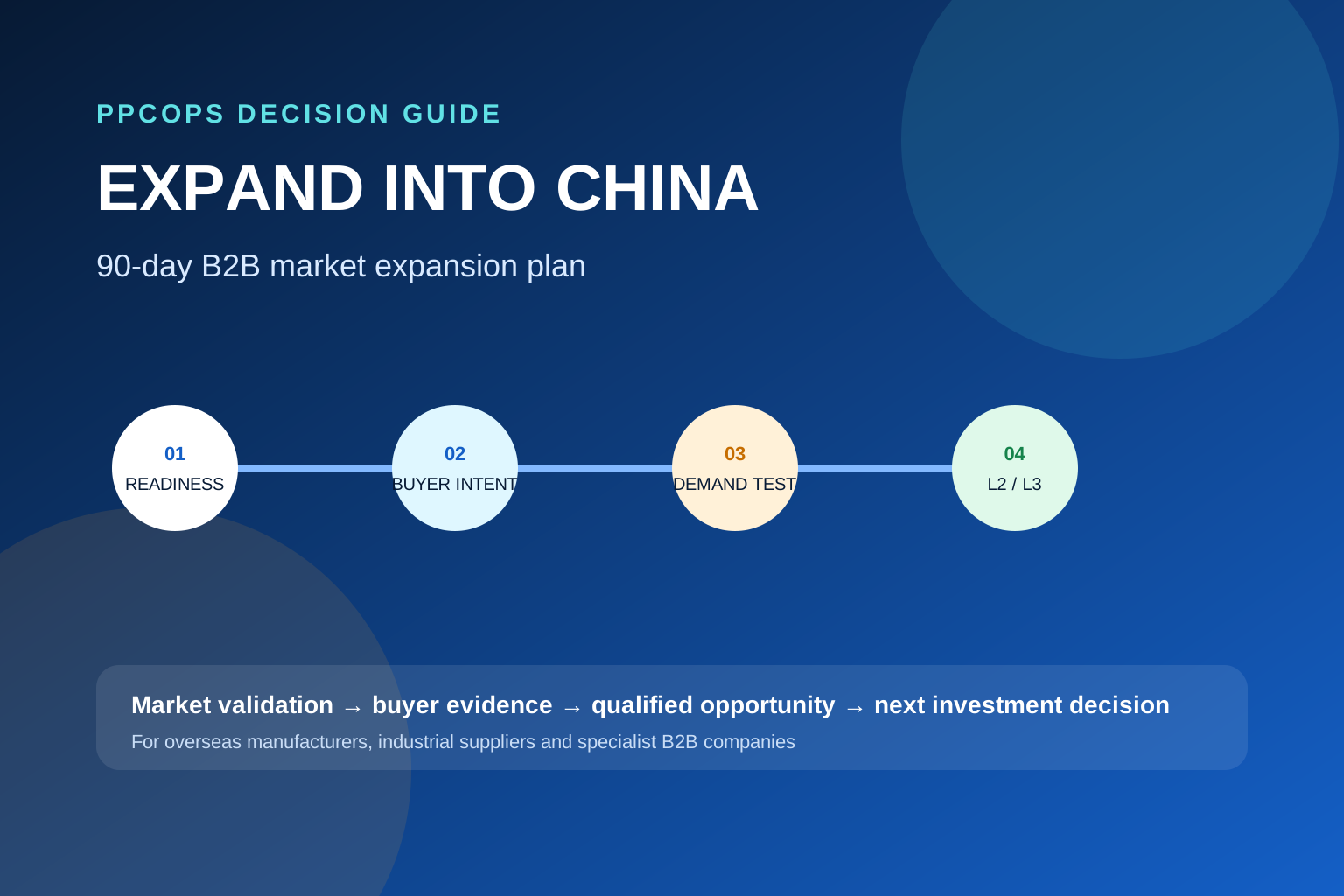
To expand into China, a B2B company needs more than a translated website or a list of distributors. The first 90 days should create evidence about Chinese buyer demand, product-market fit, local terminology, the right acquisition route and the commercial conditions required to continue.
This plan is designed for manufacturers, industrial suppliers, technical service companies and specialist B2B firms expanding into China from overseas. It treats China market expansion as a sequence of controlled decisions rather than a promise that one campaign or one partner will produce sales.
Days 1–15: define what expanding into China must prove
Start with a narrow commercial question. Examples include whether Chinese buyers recognize the problem, whether the offer can be explained in Chinese, whether an importer or distributor route is necessary, and whether the expected order value can support local acquisition and service costs.
The target is not a generic China market report. It is a written decision brief covering the ideal customer, use case, buying role, likely objections, regulatory or account constraints, existing evidence and the next investment decision. A B2B market expansion into China should be built around a specific product line or service, not the whole company portfolio.
- Choose one priority product or service
- Define the buyer, application and sales value
- Separate demand questions from compliance questions
- Set a maximum validation budget and review date
- Record what would justify continue, change or stop
Days 16–30: translate buyer intent, not just company copy
Chinese buyers may describe a product by category, application, technical problem, material, specification, supplier type or expected result. Expanding into China therefore requires Chinese keyword and buyer-language research before advertising, content or outbound work is scaled.
The output should include search clusters, buyer questions, proof requirements and a message hierarchy for each decision-maker. This work also reveals when a global value proposition depends on assumptions that are not credible or clear in China.
- Product and application terminology
- Technical and commercial problem terms
- Supplier, manufacturer and service terms
- Price, quotation and procurement questions
- Proof, qualification and local-support concerns
Days 31–60: run two complementary demand tests
A practical expansion plan normally combines active-demand capture with a controlled market-development test. Active demand may come from Baidu search, localized landing pages and relevant Chinese content. Market development may use direct outreach, industry media, events, channel research or selected social platforms, depending on the buyer.
Do not compare channels only by clicks or raw forms. Record the keyword or outreach angle, country of the overseas advertiser, landing page, buyer type, need, timing and sales response. A small number of qualified opportunities can be more informative than a large volume of unverified contacts.
| Test route | What it can answer | Useful evidence |
|---|---|---|
| Chinese search and content | Is there active buyer demand? | Relevant search terms, engaged visits, qualified inquiries |
| Direct buyer or distributor outreach | Can the offer start a commercial conversation? | Replies, objections, role fit, next step |
| Industry media or social test | Does the message earn attention and trust? | Relevant audience response and assisted inquiries |
| Market validation interviews | Why would buyers accept or reject the offer? | Repeated needs, objections and decision criteria |
Days 61–90: move from leads to L2 and L3 evidence
For an expand-into-China program, L1 is an original contact such as a form, email or WhatsApp message. L2 is a real company with a relevant China-selling objective and a reachable contact. L3 is a qualified commercial opportunity with enough evidence about need, timing, role and next step to justify sales work.
Review performance by search term or market-development angle, country, landing page and qualification stage. Preserve UTM values and click identifiers such as gclid when available. The purpose is to learn which combination produces qualified commercial movement, not merely which source produces the cheapest contact.
Choose the next China expansion route from evidence
After 90 days, the company may continue with direct B2B lead generation, recruit and validate distributors, localize a deeper content program, test a paid assessment, or pause the market. A pause can be a successful outcome when it prevents a larger unsupported investment.
PPCOps supports foreign B2B companies with China market entry, market validation, Chinese advertising, lead generation and distributor-search execution. Results depend on the product, market, offer, budget, local readiness and sales follow-up; no agency can guarantee market approval, inquiry volume or sales.
Frequently asked questions
How long does it take to expand into China?
A controlled first validation can be organized over roughly 90 days, but licensing, localization, sales cycles and channel development may take longer.
Can a B2B company expand into China without a local office?
Often it can test demand and begin buyer or distributor conversations before opening an office, subject to the product, transaction and platform requirements.
Should market expansion start with advertising or distributors?
Choose based on buyer behavior and the decision to be tested. Search can validate active demand, while distributor work tests channel access and partner economics.
What should be measured in the first 90 days?
Measure relevant demand, L2 qualified leads, L3 opportunities, repeated objections, channel feasibility and the cost of the next decision—not only traffic.
Turn the research into a scoped China test
PPCOps helps international teams define the buyer, route, platform, localization and evidence required before committing to a larger China program.
Discuss your China project